
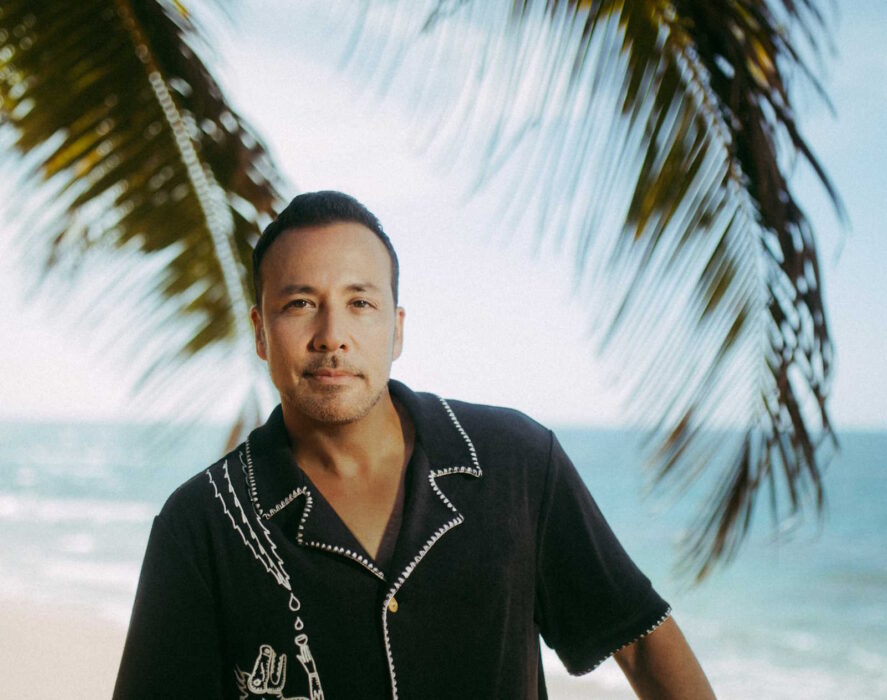
Howie D Spent Decades Feeling Like a ‘No Sabo Kid.’ Now, He’s Turning a Career-Long Insecurity Into a Love Letter to Puerto Rico
If you’re a Millennial like me, Howie Dorough probably needs no introduction. In fact, he might also be your favorite Backstreet Boy. However, there are few times in life when we have the chance to reintroduce ourselves—especially to millions of fans who have followed you for more than three decades, and for whom you’ve been the soundtrack to their lives or, in my case, the music we turn to when we need to feel safe.
For Latinos, though, Howie D. plays a dual role. He wasn’t just a Backstreet Boy. He was the Latino Backstreet Boy who, in an era when Latino representation in mainstream music was practically nonexistent, made us feel a little seen.
Today, more than three decades later, and after having sold more than 135 million albums throughout his career as a founding member of one of the biggest boy bands in history, Howie is finally embracing that part of his identity without hesitation—and in a race against the clock that brings him much closer to his heart. He’s creating music that’s unmistakably and distinctly Puerto Rican, in Spanish—a language he’s still teaching himself as he goes along, at age 52—and he recorded this interview the day before his birthday, still riding the momentum of a song he released without much expectation.
How Howie D’s Puerto Rican Mother Met His All-American Father
Howie’s mother came to the mainland from Puerto Rico around age 19, one of eight siblings, to visit a sister attending college near Georgetown in Washington, DC. She met Howie’s father, an Army soldier from Georgia of Irish descent, at an amusement park. He kept bumping into her in the bumper cars. “It was kinda almost like The Notebook,” Howie says. They wrote letters while he was stationed nearby, married about a year and a half later, and had three children in the DC area before his father took a job with the Orlando Police Department and moved the family to Florida, where Howie was born. He is, in fact, the youngest of five by ten years, a gap he and his siblings still joke about. “I always say with my brothers and sisters, it’s a little Catholic oops,” he says. “I say it’s a Catholic blessing to the family.”
The house Howie grew up in was Puerto Rican in almost every way except the language spoken inside it. His mother filled it with José Feliciano’s “Feliz Navidad” at Christmas, with Julio Iglesias and Celia Cruz, a gentle Caribbean hum that was always there. He remembers, as an adult, arranging for his mother and her older sister, both now in their 90s, to meet Julio Iglesias in Melbourne, Florida, through his friendship with Iglesias’s son Enrique. “They were probably in their 80s at the time,” he says, “but they were fangirling as if they were teenagers.”
However, speaking Spanish was never a priority. His mother was still learning English when Howie was a kid, and, like many immigrant parents of her generation, she leaned toward making her children as American as possible rather than bilingual. In fact, Howie grew up in an Orlando neighborhood where his was the only half-Hispanic family on the block, a detail he finds funny now given how much the city’s Puerto Rican population has grown since. “When you came to my house, you knew it was a Spanish house,” he says. “The only thing you didn’t really hear was Spanish.”

Howie D’s Road to Spanish Fluency Took a Backstreet Boys-Sized Detour
Back then, if you had the slightest connection to Latino culture, you were, well, typecast. For every and all opportunities, Howie was asked to at least speak Spanish and be the Latino in the project.
To this day, he remembers exactly how it felt to sit across from a casting director who’d call him in for a role because he looked the part, then hand him a script in Spanish. “No hablo español,” he’d have to admit. “Huh? We don’t understand this,” they’d say back, and the part would go to somebody else. It happened often enough that it eventually cost him more than a single audition. It cost him a real shot at joining Menudo, the Puerto Rican boy band, around the years Ricky Martin was still in the lineup. “They loved me and everything,” he says, “but the fact that I didn’t know Spanish stopped the opportunity from happening.”
The audition rejections finally caught up with him around age 14, when he decided he needed to actually learn the language he kept getting cast to represent. He studied Spanish for three years in high school, took it in grammar school, completed two years of college coursework, and even took Berlitz courses. He got good enough that he started dreaming in Spanish and could follow the news. The next step, he was told, was immersion. In order to be perfectly fluent, the best was to move in with a family in Mexico or South America to live in the language day to day. And he wanted to. But he had just joined a new group called the Backstreet Boys, who had already waited two years for him to finish his Associate of Arts degree before he could commit full time. “They said, ‘Howie, at this point it’s hard for us to wait another six months. We’re ready to go. Let’s go,’” he says. The immersion trip never happened, and over the following decades, most of what he’d built faded. “Solamente para hablar en presente,” he says now, laughing at himself. “Mi conversación es mala. No recuerdo [los verbos en] pasado ni en futuro.”
Why Howie D Finally Felt Ready to Sing in Spanish
For years afterward, Howie stayed away from a Latin project out of the same fear that had followed him since those early auditions, that someone would start speaking to him at full speed and expose exactly how much he’d lost. He also credits timing within the band itself. Backstreet Boys, he says, has always come first, and he sees that as a mutual agreement among all five members rather than a sacrifice unique to him. “If each of us tried doing solo careers at the exact same time, there would not be a Backstreet Boys,” he says. “Somebody has to sacrifice.”
However, this did not diminish his desire to connect with his identity. In fact, thanks to Howie D, a band as successful in the English-language market as the Backstreet Boys decided to cover its songs in Spanish, including “Nunca Te Haré Llorar” and “Donde Quieras Yo Iré.”
This Is Why, in the Last Year or Two, He Decided It Was Finally His Turn to Go All In
And two things moved him past the fear. One was the culture around him shifting, artists like Bad Bunny and entire K-pop groups building global audiences in languages other than English. “I feel ready for the world to embrace me,” he says, “and I think hopefully the world’s ready to embrace me as well.” The other was hearing, over and over across years of meeting fans, some version of the same story. Many fans, including the one who writes this piece, learned English by transcribing Backstreet Boys lyrics.
And for those who have always had access to the internet and information on social media, this may sound trivial. But in the 1990s—especially if you lived in Latin America—learning English really required a monumental sacrifice, not to mention the financial means to afford specialized language courses. But thanks to bands like the Backstreet Boys, many of us learned not only the words but also the context and the slang.
For Howie D, who has struggled his whole life to learn his mother’s language, hearing that directly from his fans was the final push he needed to embark on this new chapter in his professional career.
Instead of writing a Latin album from scratch, he decided to translate his own catalog into Spanish and relearn the language through his own songs, just as his fans had done. Talking it through in this conversation, he got emotional enough to apologize for the tears in his eyes, adding that he’s also learning to embrace that emotionality. “As I’ve gotten older, I have truly learned just to embrace it,” he says.
But most importantly, part of what’s driving the urgency, too, is his 92-year-old mother. “I wanna make sure that when Abuela’s gone, the tradition doesn’t stop,” he says. “The heritage is still in us.” mitú’s own audience is built largely around what’s come to be called “No Sabo kids,” Latinos who grew up around Spanish without ever fully claiming it. When the term came up in conversation, Howie admitted he’d only recently learned it. He didn’t need it explained twice.
Making Coquí: Howie D’s Love Letter to Puerto Rico
The song that started all of this, “Coquí,” wasn’t the plan. Howie set out with a Dominican producer to translate an existing Backstreet Boys track into Spanish, experimenting with reggaeton and Afrobeats layered under it. The sound felt fresh enough that they abandoned the translation altogether and wrote something new. And in the tradition of old-school storytelling, the song is not a strictly true story; Howie is careful to point out. The young woman in the “Coquí” video isn’t his wife. “You make music to entertain people,” he says. But the emotional core is his own: learning a language he was never taught fluently, and claiming an island, Puerto Rico specifically, that shaped him regardless. Once the song existed, he decided within 24 hours that the song’s video had to be filmed there. Two days later, he flew from Miami to Puerto Rico and shot two videos in one trip, “Coquí” and a Spanish version of a song called “All I Have to Give,” near El Yunque rainforest rather than San Juan, the part of the island his mother’s family history is rooted in.
What’s more, once his Backstreet Boys earnings allowed it, the first thing Howie D did was buy his mother a house in that same resort area years ago. And here’s where that emotionality completely took over our conversation. He explained his family wasn’t wealthy when he was growing up. Several of his mother’s sisters married doctors; she married a police officer, and money was tight. “Mom,” he remembers telling her, “we no longer have to stay at your sister’s houses. I’m gonna get you a house there.” The house is still his own getaway today, and he says returning keeps him tied to where his mother’s side of the family comes from.
At 92, she had the opportunity to hear “Coquí,” her son’s first solo song written and performed entirely in Spanish, making it a full-circle moment for both of them. “Of course she cried,” Howie says. “It made me cry.”
When Two Passions Finally Coincide, 33 Years Later
Unlike his two previous solo albums, both released through record labels on a fixed schedule, Howie is running this project independently with a team he assembled himself, which means he controls the timeline. “Coquí” went out in early summer with modest expectations, meant to be a good-vibes song for the season. It has since climbed to number 21 on the contemporary Latin charts, and that unexpected momentum has changed his plans. Rather than rushing out the next single, “All I Have to Give,” he’s holding back to see where the attention leads, including possible talks about a featured Puerto Rican artist on “Coquí” and conversations with radio programmers who keep pushing him toward names like Farruko.
In the meantime, he’s been performing the new material live in small doses. During the band’s Las Vegas residency, he hosts something he calls Cafecito con Howie, Friday morning acoustic sets for fans where he plays “Coquí,” the Spanish version of “All I Have to Give,” and Backstreet Boys staples like “Spanish Eyes” and “I Want It That Way.” He and bandmate Nick Carter do after-show sets together on Fridays, trading solo material back and forth. “He’s always like, ‘Check out Howie with Coquí, it’s hot,’” Howie says. He credits the band’s 33 years together to that kind of support rather than competition between members, and says every solo detour, his included, sends him back to the group stronger than before.
The kid who once had to admit “no hablo español” in front of a casting director is now hoping his music does something no audition ever could: bring new Latino fans into a group he’s spent more than half his life with. “I wanna honor my fans around the world,” he says, “and definitely wanna make sure this project comes to fruition.”